Articles
Concrete Meets Code: How Emmaus Åland is Reinventing Building Material Reuse Through Digital Innovation
Text: Miira Ojanen/Renet, photo: Emmaus Åland
Can an established social organization on a remote island become a frontrunner in Finnish circular economy? Emmaus Åland and its partners are demonstrating that it can. By combining practical reuse infrastructure with emerging digital tools, Åland Emmaus is boldly participating in developing local solutions that turn construction and building waste into measurable environmental and economic value.
Driven by its geographic isolation, Åland Islands has already developed a strong local circular economy mindset. Limited transport connections make resource efficiency not only desirable, but necessary. In this context, organizations like Emmaus Åland play a central, consistant and long-term role in reuse, repair, second-hand operations, and material recovery.
The biggest challenge is logistics: because Åland Islands is geographically isolated, transporting waste, especially textiles, off the island is expensive and environmentally inefficient. This creates a strong motivation for total local reuse and recycling solutions, says Robert Jansson, director of Emmaus Åland.
According to Jansson, used textiles remain one of the region’s most difficult waste streams. About 45 % of collected textiles still need to be exported for processing to countries such as Estonia and Poland. The long-term ambition is to significantly reduce or eventually eliminate exports altogether by building fully local systems for reuse, upcycling, and recycling. But other material fractions need solutions too.
(Re)building Sustainably: Ongoing Hardware-Digital Project
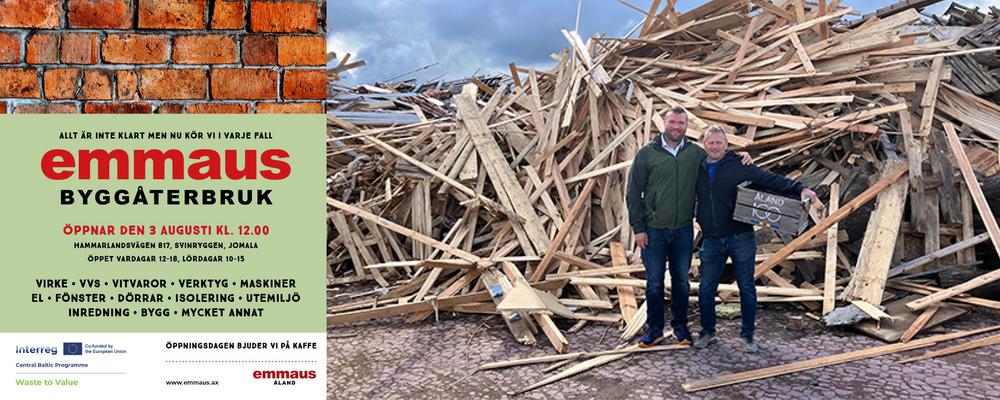
A major current initiative at Emmaus Åland is theWaste to Value Project supported by the EU’s Central Baltic Interreg programme. The project focuses on reducing construction waste and increasing the local reuse and recycling of building materials.
The three-year-pilot target is to recover minumum of 108 tons of building materials for diverse circular uses.
Key components of the project include:
A new 1,500 m² reuse facility connected to the recycling center, where construction materials are sorted for reuse before being redirected to recycling or energy recovery.
Active influencer work on identifying and addressing legal and regulatory barriers that currently limit reuse of construction materials in Finland and Sweden.
Digital Innovation: Tracking Reuse in Real Time
One of the most innovative elements of the project is the development of their own digital system.
The system is being designed as a customized application that will:
Scan and register incoming materials
Track volumes and weight of reused items
Calculate environmental impact, including CO₂ savings
Generate standardized reporting data for sustainability and circular economy monitoring of building materials
The tool is intended not only for internal operations, but could also have potential to be a scalable SaaS model for other reuse and recycling organizations. It is designed to integrate with local recycling and waste management infrastructure and align with EU waste reporting categories.
Island Living, Circular Thinking
Emmaus Åland represents an emerging model for how small, geographically isolated regions can combine physical infrastructure and digital innovation to build scalable circular economy systems. By linking material recovery with data-driven tracking, the project demonstrates how reuse can move beyond manual processes into measurable, transparent, and scalable systems aligned with the waste hierarchy.
As the project develops, it may serve as a reference point for other regions in Finland (and elsewhere) aiming to build localized, high-impact circular economy solutions.
Emmaus Åland, Hammarlandsväden 817, Gottby, Finland
Read more about Emmaus Åland and their circular economy work: www.emmaus.ax